
A lift maintenance company in Singapore inspects and services lift equipment, diagnoses faults, carries out repairs, responds to breakdowns within its agreed coverage, and documents the work. It also helps coordinate statutory testing and maintenance planning. The exact service depends on the lift, applicable requirements and the maintenance contract.
For building owners, this means knowing who checks the equipment, who responds when something goes wrong, which costs are included, and what evidence comes back after each visit.
If you are asking, “What does a lift maintenance company in Singapore do?”, the most useful answer is a clear breakdown of those responsibilities. Whether you manage a condominium, office or industrial property, that understanding helps you ask better questions before signing a service agreement.
For the broader picture, start with our complete guide to lift and elevator maintenance in Singapore.
The Main Responsibilities of a Lift Maintenance Company
A contractor looks after the lift’s operating condition through planned maintenance and corrective work. It should also explain defects, outstanding actions and any limitations affecting the service it can provide.
The work usually falls into six areas:
- Assessing the equipment and reviewing its service history.
- Carrying out scheduled checks, cleaning, lubrication and adjustments.
- Investigating faults and recommending appropriate repairs.
- Providing the agreed breakdown and emergency support.
- Recording completed work and supporting statutory testing arrangements.
- Advising on replacement parts and longer-term upgrades.
Professional lift care also involves coordination with the building team: arranging access, agreeing service windows and communicating when equipment will be unavailable. Building managers should know which findings need immediate attention and which can be included in a planned budget.
Our article on why regular lift maintenance matters in Singapore buildings explains the wider safety and reliability benefits.
What Happens During a Routine Lift Servicing Visit
A routine visit should follow an equipment-specific maintenance plan. Before working on the lift, technicians need the relevant service history, access arrangements and information about recent complaints.
A useful way to understand the process is:
- Review: Identify reported symptoms, previous defects and outstanding recommendations.
- Prepare: Put the required worksite safety measures in place and coordinate the interruption with building management.
- Service: Complete the scheduled inspections, cleaning, lubrication and adjustments appropriate to the equipment.
- Check and report: Verify the work performed, record unresolved issues and explain the next action.
Effective elevator servicing depends on what the equipment needs. The scope and duration can change when a technician discovers a defect requiring further investigation.
For the timing of visits and the differences between lift categories, see how often lifts should be serviced in Singapore.
Which Lift Components Do Technicians Check?
Checks cover mechanical, electrical and passenger-safety systems. The equipment design determines which components are present and which procedures apply.
| Area | Examples of checks |
| Doors and protective devices | Door movement, interlocks, sensors and reopening operation. |
| Machine, drive and brakes | Condition, mounting, leakage and braking performance. |
| Suspension and guidance | Ropes or belts, guide shoes, rollers and guide rails, where applicable. |
| Controller and electrical system | Wiring condition, connections and signs of abnormal operation. |
| Emergency equipment | Alarm, two-way intercom, emergency lighting and backup supply. |
| Travel and stopping | Unusual noise, vibration and floor-level accuracy. |
| Machinery spaces and lift pit | Cleanliness, debris and conditions affecting safe access or equipment. |
These areas are covered in BCA’s Lift Maintenance Outcome Guidebook. This is an owner-facing summary, rather than a technical procedure or a complete maintenance checklist.
Good elevator care requires more than a clean cabin. Internal checks belong with qualified personnel; building staff should report symptoms without opening panels or entering restricted lift spaces.
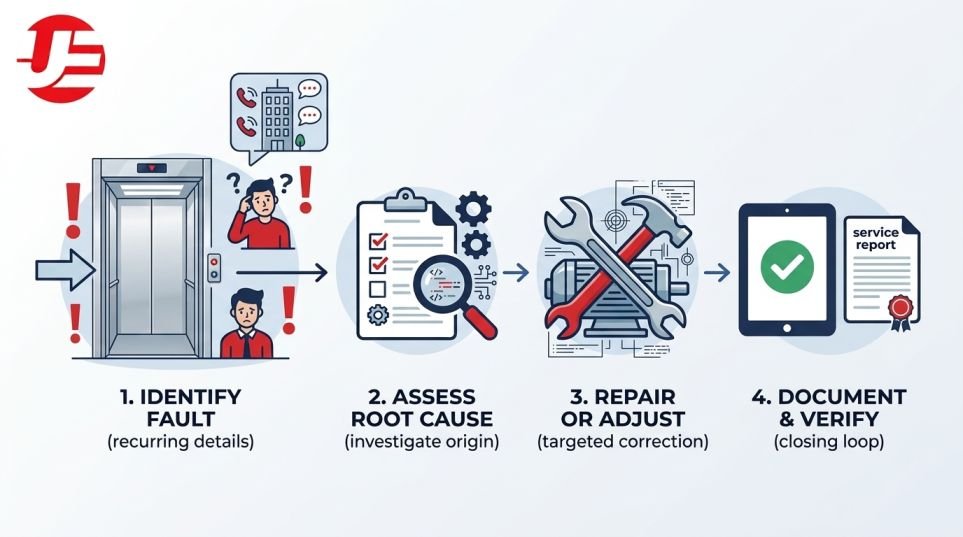
How Are Recurring Lift Faults Diagnosed and Repaired?
When the same fault returns, the contractor should investigate the underlying cause and explain its findings. Repeated resets alone do not show that a defect has been resolved.
Consider an illustrative example: a lift repeatedly reopens its doors at one landing. The symptom could involve an obstruction, alignment, a protective device or another fault. The technician needs to assess the actual equipment before deciding what to adjust or replace.
The owner can help by noting the floor, time, observed behaviour and whether the problem happens repeatedly. This gives the contractor more useful information than “the lift is acting strangely”.
Ask for a clear explanation of the diagnosis, proposed work and checks completed afterwards. Consistent lift upkeep depends on closing the loop between a passenger complaint, a technical finding and a documented resolution.
What Support Is Available During a Lift Breakdown?
A maintenance provider may offer a staffed reporting line, technician dispatch and assistance with passenger entrapments. The hours, priorities and charges should be stated in the agreement.
When comparing support, distinguish between:
- Call acknowledgement: When someone receives the report.
- Technician response: When a technician is dispatched or arrives, as defined in the contract.
- Restoration time: When the lift can safely return to operation.
These are different commitments. A quick telephone response does not establish how long a repair will take, particularly when a replacement part is needed.
Union Jack Elevator provides a 24-hour call centre and emergency contact service. Ask the team how this support applies to your equipment and proposed agreement.If passengers are trapped, they should use the alarm or intercom and await trained
assistance. Building staff should not attempt to force doors or carry out a rescue themselves.
How Does the Company Support BCA Compliance?
What does a lift maintenance company in Singapore do to support compliance? It carries out the required maintenance, documents the work and helps coordinate testing and defect rectification within its appointment.
According to BCA’s periodic maintenance requirements, most ordinary shared-building lifts require maintenance at least monthly, or more frequently if the manufacturer recommends it. Specific categories have different rules, and approved remote monitoring and diagnostics arrangements may follow an authorised schedule.
BCA lists annual lift inspection and testing by a registered fixed installation service contractor with an independent Specialist Professional Engineer (SPE) present. Routine servicing does not replace this process.
The owner or authorised representative also has a role in Permit to Operate administration through LEAP. Agree who coordinates appointments, documents and renewal steps. A maintenance contract should make those responsibilities clear.
What Maintenance Records Should Building Owners Receive?
A useful service report tells the owner what happened during the visit and what remains unresolved. Ask for information that supports decisions, including:
- The lift identifier, date and work completed.
- Defects found and their practical significance.
- Adjustments or parts replaced.
- Checks performed following the work.
- Recommended follow-up, priority and responsible party.
- Any separate quotation or planned downtime needed.
Keep the reports alongside breakdown records, repair approvals and testing documents. For an MCST or facility team, this creates a shared record when responsibilities change hands.
To make elevator upkeep easier to manage, ask the contractor to highlight repeated faults and open actions at review meetings. A report saying only “serviced” gives you little basis for assessing whether recurring problems are improving.
What Is Included in a Lift Maintenance Contract?
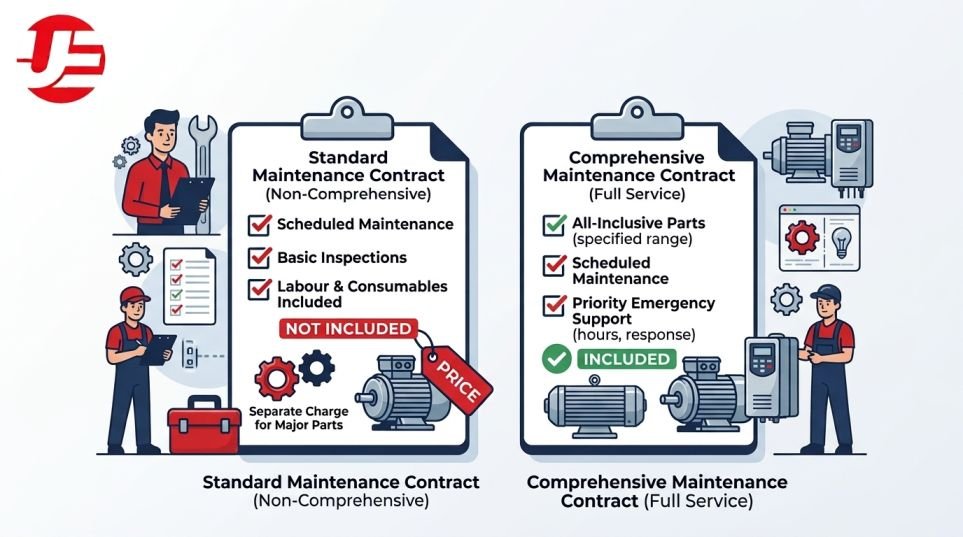
Coverage depends on the written agreement. Terms such as “standard”, “comprehensive” and “full service” need a clear schedule of inclusions and exclusions.
| Contract area | What to confirm |
| Scheduled maintenance | Tasks, visit frequency, access and service windows. |
| Labour and parts | Included components, consumables and separately chargeable work. |
| Breakdown support | Coverage hours, response definitions and call-out charges. |
| Testing coordination | Responsibility for arrangements and any separate fees. |
| Reports | Information provided, delivery method and review arrangements. |
| Exclusions | Treatment of misuse, external damage, obsolete parts and major upgrades. |
Generally, a non-comprehensive agreement leaves more replacement costs to be quoted separately. A comprehensive agreement includes a broader range of specified repairs or parts while retaining exclusions. BCA’s Good Practices Guide for Lift Owners explains this distinction.
Compare the whole scope of elevator servicing before comparing prices. Ask how approvals and parts procurement will work when a fault falls outside the agreement.
How Do You Choose the Right Maintenance Company?
Once you understand the scope, turn “What does a lift maintenance company in Singapore do?” into questions about your own building.
Start by checking the contractor’s current registration in BCA’s lift maintenance contractor directory. Then ask for evidence of experience with your lift brand, model and building type.
Useful questions include:
- Can you show a sample report with defects and follow-up actions?
- What diagnostic tools and technical support are available for this model?
- How will you obtain parts that are difficult to source?
- Who handles urgent calls and unresolved repeat faults?
- What needs to be handed over from our current contractor?
Request a written scope after an equipment assessment. Meaningful lift care starts with understanding the actual installation, including any limitations that could affect the proposed service.
When Should a Company Recommend Repair or Modernisation?
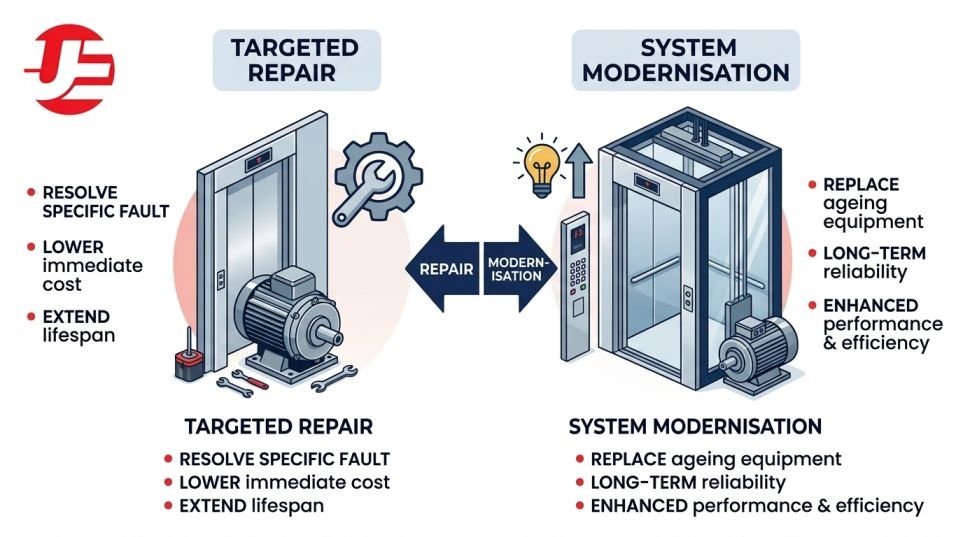
A contractor should explain whether a targeted repair can address the problem or whether a wider upgrade deserves consideration.
Ask it to separate three decisions: restoring a failed component, planning replacement of ageing equipment, and modernising a larger part of the system. Each has a different scope, cost and disruption to occupants.
A useful recommendation explains the fault history, component condition, parts availability and expected consequences of each option. Request the reasoning in writing so your team can review the proposal and budget accordingly.
Long-term elevator care includes planning for these decisions before a failure leaves the building with limited choices. For available upgrade services, explore Union Jack Elevator’s modernisation solutions.
Frequently Asked Questions
What does a lift maintenance company in Singapore do for an MCST?
It services the common-property lifts, investigates faults, provides agreed breakdown support and reports findings to the appointed building team. It can also support testing arrangements and repair planning. The contract should specify the respective duties of the contractor, managing agent and MCST.
Does routine maintenance include every repair?
No. Inclusion depends on the contract, affected component and cause of the fault. Ask which labour, parts and call-outs are covered before approving a lift servicing agreement.
Can a company maintain lifts installed by another manufacturer?
Some providers offer multi-brand maintenance. Confirm their capability for the specific model, including access to diagnostic tools, technical information and compatible parts. Union Jack Elevator advertises maintenance and repair services across lift brands.
Can building staff carry out maintenance themselves?
Building staff can report unusual behaviour and support agreed housekeeping arrangements in public areas. Technical lift upkeep, adjustments and work in restricted spaces should be left to the appointed qualified personnel.
What should we send when requesting a quotation?
Provide the site address, number of lifts, brands and models if known, approximate equipment age, current contract end date and recent fault history. Sharing existing reports helps the company ask relevant questions before assessing the equipment.
Discuss Your Building’s Maintenance Needs with Union Jack Elevator
At Union Jack Elevator, our published maintenance and modernisation portfolio includes Our Tampines Hub and Katong Plaza. Our service offering covers inspections, troubleshooting, parts replacement, testing and modernisation.
When discussing your building, ask us about the work relevant to your lift model and operating needs. A clear conversation about existing faults, service coverage and future repairs helps you assess whether the proposed arrangement fits your property.
For planned elevator upkeep, contract enquiries or help reviewing maintenance needs, contact Union Jack Elevator with your lift details and recent service reports.
Tell us what your building needs, and request a maintenance proposal with a clearly defined scope.