
Wondering How Often Should Lifts Be Serviced in Singapore? The required frequency depends on the type of lift, where it is used, and the applicable Singapore’s standards. For Lift owners, regular servicing is an important part of keeping equipment safe, reliable, and compliant.
The schedule can differ between General Lifts, Home Lifts and Platform Lifts, so it is important to understand the correct maintenance interval rather than follow a one-size-fits-all approach. Regular checks also help registered contractors identify potential issues before they become bigger maintenance problems.
Quick Answer: Most Lifts in Singapore Require Servicing at Least Once a Month
Under Singapore regulations, most passenger lifts require monthly servicing by a registered contractor. The Building and Construction Authority (BCA) generally requires servicing at least once a month or according to the manufacturer’s recommended schedule, whichever is more frequent. This regular care helps prevent small faults from becoming serious problems.
- BCA regulations: The regulatory servicing requirements provide the minimum servicing standard for most lifts in Singapore. Following these safety requirements supports better lift safety and legal compliance.
- Service frequency: The correct service frequency depends on lift usage, age, condition, and manufacturer guidance. High-traffic buildings may need a greater maintenance frequency and a more strict servicing schedule.
- Maintained lifts: Properly maintained lifts are less likely to experience sudden failures, door problems, or uneven stopping. Consistent lift maintenance also helps technicians identify worn parts before they cause breakdowns.
- Specialized residential setups: Certain specialized residential setups, such as some home lifts and stairlifts, may follow quarterly servicing. Depending on the lift category and manufacturer’s guidance, servicing may be required every three months.
- Residential lift servicing: A suitable residential lift servicing plan should match the equipment type and how often the lift is used. In practice, checking the manufacturer’s schedule before setting service dates helps owners avoid missed maintenance.
BCA Lift Maintenance Frequency Requirements in Singapore
In Singapore, the Building and Construction Authority (BCA) sets clear BCA maintenance requirements for different lifts. These lift servicing requirements determine how often each system must receive professional care. A registered fixed installation (FI) service contractor must perform the required routine servicing and lift maintenance.
The correct service frequency and maintenance frequency depend on the lift type and the manufacturer’s recommendation (MR). Building owners must follow the manufacturer’s recommended frequency or the legal minimum, whichever is more frequent.
- Single residential unit lifts: Single residential unit lifts should follow the manufacturer’s instructions or receive quarterly maintenance when there is no manufacturer’s recommendation. In that situation, servicing is required once every 3 months, creating a clear 3-month servicing interval.
- Non-single residential lifts: Certain non-single residential lifts, including stairlifts and vertical platform lifts, must follow a manufacturer-specified schedule. They must otherwise be serviced every 3 months, whichever interval is more frequent.
- Remote monitoring and diagnostics (RM&D): An approved remote monitoring and diagnostics (RM&D) system may allow a different maintenance schedule when active remote diagnostics are used. The Commissioner of Building Control must provide written approval for the approved remote diagnostics arrangement.
- Statutory testing requirements: Regular servicing does not replace the statutory testing requirements applying to lifts. Every lift must undergo annual inspection and testing, including a comprehensive annual examination of its operation and safety systems.
- Annual inspection: The required annual inspection includes an annual test performed under the applicable BCA process. This annual testing remains separate from monthly or quarterly servicing.
Servicing Frequency for Different Types of Lifts
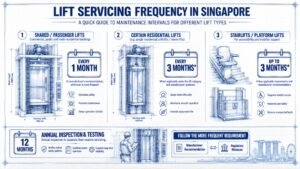
The right servicing frequency depends on the lift type, usage, and local safety rules. Always follow the manufacturer’s manual recommendations when they require more frequent servicing.
Commercial and Public Lifts
- High-traffic passenger lifts: Lifts in offices, hotels, and hospitals face heavy passenger traffic and greater lift usage intensity. A monthly service schedule with monthly checks helps maintain reliability.
- Service every 1 month: Most low-rise commercial lifts should service every 1 month under Singapore requirements. Both commercial lift maintenance and public lift servicing must follow the applicable schedule.
- Extreme heavy-use areas: Some buildings may need bi-weekly servicing because of unusually heavy use. A general 1-to-3-month service interval should not replace Singapore’s monthly requirement.
Residential Lifts
- Multi-family residential lifts: Shared multi-family residential lifts normally need monthly service, even with low usage or fewer than 6,000 trips a month. Their residential servicing frequency must follow BCA rules and manufacturer recommendations.
- Private home lifts: Some private home lifts and low-use home lifts with minimal usage may follow a longer home lift maintenance interval. Advice to service every 3 to 6 months, use twice-yearly servicing, or service every 1 to 3 months must match the legal category of the residential lifts.
Specialized and Service Lifts
- Goods lifts: Goods lifts and freight elevators face different weight loads and levels of industrial activity. Any 3-to-6-month servicing plan for freight lift servicing must meet Singapore requirements.
- Platform lifts and stairlifts: Platform lifts, stairlifts, specialized lifts, and other service lifts need a suitable service schedule and specialised lift maintenance. General advice to service every 3 to 6 months, or use a 6-to-12-month service interval for dumbwaiters, must be checked against BCA rules.
Key Factors Impacting Schedule
- Usage volume: More daily trips cause faster component wear and create tighter service windows. Busy lifts may therefore require more frequent care.
- Age of equipment: Lifts older than 15–20 years often need frequent preventive checks. Strong preventive maintenance helps detect ageing parts early.
- Environment: Dust, heavy moisture, and outdoor weather conditions can affect the lift condition. These risks may require increased servicing.
- Legal mandates: Singapore’s safety rules determine the minimum maintenance schedule and required routine maintenance. An independent safety inspection includes a thorough examination, while general testing guidance of every 6 to 12 months must align with Singapore law.
When Monthly Lift Servicing May Not Be Frequent Enough
Monthly lift servicing is suitable for many lifts, but a 30-day maintenance cycle may be too long under demanding conditions. The correct maintenance frequency should reflect the actual lift condition, usage pattern, and fault history. In practical maintenance planning, operating data is often more useful than relying only on fixed dates.
- High-traffic lifts: Lifts in high-rise commercial buildings, public transport hubs, stations, and metro systems handle continuous public traffic. These systems may require more frequent attention to remain reliable.
- Heavy passenger demand: Constant peak-hour crowds and daily passenger loading increase system cycles beyond normal operating thresholds. This additional heavy passenger demand can cause parts to wear faster.
- Aging equipment: Accelerated mechanical aging, obsolete equipment, and old lift systems may operate beyond their prime lifecycle window. This can cause rapid component fatigue, component wear, wear progression, and accelerated wear.
- Harsh environmental conditions: Environmental and operational stressors, including high humidity, dust, and extreme temperature shifts, can increase environmental wear and operational stress. These conditions may cause electronic degradation and seal degradation.
- Frequent minor fault codes: Recurring minor stoppages can show that existing servicing is not controlling deterioration. Problems affecting braking mechanisms, door operators, or lift cables may lead to unexpected breakdowns and serious safety hazards.
- Insufficient service frequency: A schedule showing insufficient service frequency should be supported with preventive servicing and targeted preventive checks. Depending on risk and usage, a contractor may recommend bi-weekly checks or weekly checks.
Key Factors That Determine How Often a Lift Should Be Serviced
The right maintenance frequency depends on how the lift operates, where it is installed, and its legal category. A reliable regular lift service plan combines proper lift maintenance with practical service intervals. In practical maintenance planning, actual usage and fault records often provide the clearest guidance.
- Lift usage: Different usage levels and usage volume create different maintenance needs. High-traffic buildings, heavy daily passenger traffic, and freight traffic usually need more attention than low-use systems.
- Equipment condition: Lift age is important because older machines generally require more frequent checks than new units. Technicians should monitor component wear and parts wear when deciding the next service date.
- Planned schedule: Most shared lifts in Singapore require monthly checks, while certain qualifying lift categories may follow quarterly service. Building owners should use strict service schedules based on BCA requirements and manufacturer guidance.
- Legal compliance: Singapore’s legal rules, local safety laws, and building codes set minimum servicing and testing duties. An annual service or inspection does not replace required monthly or quarterly maintenance visits.
Routine Lift Servicing vs Annual Inspection and Testing
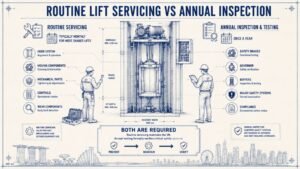
Routine lift servicing maintains the lift throughout the year, while annual inspection and testing provides a formal safety review. The correct service frequency depends on the lift type, usage levels, and condition of the lift equipment. From a practical maintenance viewpoint, both processes are necessary because they serve different purposes.
Routine service schedule: Most shared lifts require monthly servicing, while specific lift categories may qualify for quarterly servicing. Semi-annual servicing should only be used when it meets the manufacturer’s instructions and Singapore requirements.
- Mechanical adjustments: Technicians perform tightening loose bolts, small adjustments, and basic door alignment during routine visits. This limits daily wear and improves long-term component care.
- Operational benefits: Regular maintenance supports smooth operation and better lift reliability. It also improves breakdown reduction and can extend machine life.
- Routine maintenance provider: A trained routine maintenance technician normally carries out scheduled servicing. The appointed service contract provider should document completed work and report developing faults.
Annual inspection process: The annual testing frequency is normally once a year and involves a formal inspection. This in-depth inspection includes controlled inspection tasks and a formal safety audit.
- Safety system testing: Lift safety testing provides documented safety verification of critical parts. It may include full-load safety tests, emergency brakes, governor checks, buffer tests, and other major safety systems.
- Compliance review: Annual testing supports legal compliance and confirms critical safety compliance. The process can include structural compliance audit and checks against applicable legal codes.
- Qualified inspection parties: General guidance may refer to a certified third party, independent certified inspector, or statutory examiner. In Singapore, the work must involve the qualified parties required by BCA, which may include a senior specialist with the appropriate registration.
Signs Your Lift Needs Attention Before Its Next Scheduled Service
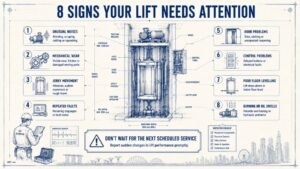
Warning signs can vary by type of lift, whether it is a passenger lift, goods lift, hydraulic lift, or stair lift. Any sudden change in lift condition should receive prompt lift attention rather than waiting for the next service date. In practical fault reviews, recognising early maintenance warning signs often prevents larger failures.
- Unusual sounds: Record the exact sounds or behaviours and any changes in normal lift behaviours. Grinding or scraping sounds, strange noises, rattling, squeaking, or other exact sounds should be checked promptly.
- Mechanical wear: Damaged moving parts, or unmet lubrication needs can cause friction wear. Misaligned cables, mechanical stress, and structural wear can develop into serious faults.
- Poor ride quality: Changes in ride quality, including jerky movements, uneven movement, vibrations during travel, or sudden stops, require inspection. They may indicate drive system failure, failing brakes, or a risk to lift safety.
- Repeated faults: Frequent minor breakdowns can show that wear is developing faster than the current service schedule can manage. A qualified technician should begin troubleshooting specific issues before the problem becomes more serious.
- Door problems: Changes in door operation may appear as door and levelling malfunctions, hesitant,sticking or slow door response. Unexpected reopening, dirty tracks, and failing sensors also require attention.
- Control problems: Faulty control buttons or a delayed button response may point to damaged electrical circuits. Worn control relays or another electrical fault should be checked before normal use continues.
- Levelling problems: Poor floor levelling or reduced levelling accuracy can cause unlevel stops. If the cabin position rests above floor level or below floor level, it creates a severe trip hazard.
- Critical warning odors: Burning, rubber or hot wire smell may indicate dangerous electrical overheating and possible lift fire risk. Strong oil smells can point to problems in the hydraulic system, including hydraulic fluid leaks.
Conclusion: Build a Compliant Lift Maintenance Schedule with Union Jack Elevators
The right lift maintenance schedule depends on the lift type, usage, age, operating environment, manufacturer guidance, and BCA requirements. Most shared lifts in Singapore require monthly servicing, while certain home lifts, stairlifts, and platform lifts may follow different intervals. Routine servicing, annual testing, accurate records, and early attention to warning signs all help protect passengers and reduce unexpected breakdowns.
Union Jack Elevators can help building owners and facility managers create a practical, compliant maintenance plan tailored to their equipment. With professional servicing, detailed inspections, and timely technical support, your lifts can remain safe, reliable, and ready for daily use. Contact Union Jack Elevators to review your current service schedule and identify the right maintenance approach for your building.
FAQs
1. How often should lifts be serviced in Singapore?
Most passenger and shared-building lifts must be serviced at least once a month or according to the manufacturer’s schedule, whichever is more frequent. Certain home lifts, stairlifts, and platform lifts may qualify for three-month servicing intervals.
2. What is the minimum BCA lift maintenance frequency?
BCA generally requires most lifts to receive maintenance at least once every month. Different rules may apply to specific residential lifts or lifts using an approved remote monitoring and diagnostics system.
3. What is the difference between routine lift maintenance and annual inspection and testing?
Routine maintenance includes cleaning, lubrication, adjustments, and minor repairs performed throughout the year. Annual inspection and testing is a formal safety assessment that checks major systems and supports regulatory compliance.
4. What factors affect the price of a lift maintenance contract?
Pricing depends on the lift type, age, usage, number of lifts, service frequency, and contract coverage. Replacement parts, emergency callouts, major repairs, and remote monitoring may also affect the total cost.
5. How can I check whether a contractor is registered with BCA?
Search for the company in BCA’s official directory of registered contractors under the relevant lift maintenance workhead. Confirm the company name, registration status, approved work category, and expiry date before signing a contract.