
Understanding Singapore Lift Maintenance Regulations and BCA Requirements helps building owners connect everyday servicing with safety inspections, documentation and permission to operate. A lift that appears to run normally still needs an organised maintenance programme and the appropriate statutory checks.
This guide from Union Jack Elevator explains the responsibilities that matter to owners, MCSTs and facilities managers, with practical steps for planning inspections and following up on findings.
Quick Overview
- Current framework: The Building Control (Fixed Installations) Regulations 2025 took effect on 1 October 2025.
- Maintenance and testing are separate: The servicing interval depends on the lift category and applicable requirements; BCA lists annual inspection and testing for lifts within its regulatory scope.
- Qualified professionals: Use an appropriately BCA-registered fixed installation service contractor and the required independent inspection supervision.
- Permission to operate: Keep the Permit to Operate (PTO) valid and track renewal through BCA’s LEAP portal.
- Practical priority: Record findings, assign corrective actions and check completion before treating an issue as closed.
Regulatory sources checked: 6 October 2026. Requirements should be applied to the specific lift category and any applicable exemption or written approval.
What Are Singapore’s Lift Maintenance Regulations?
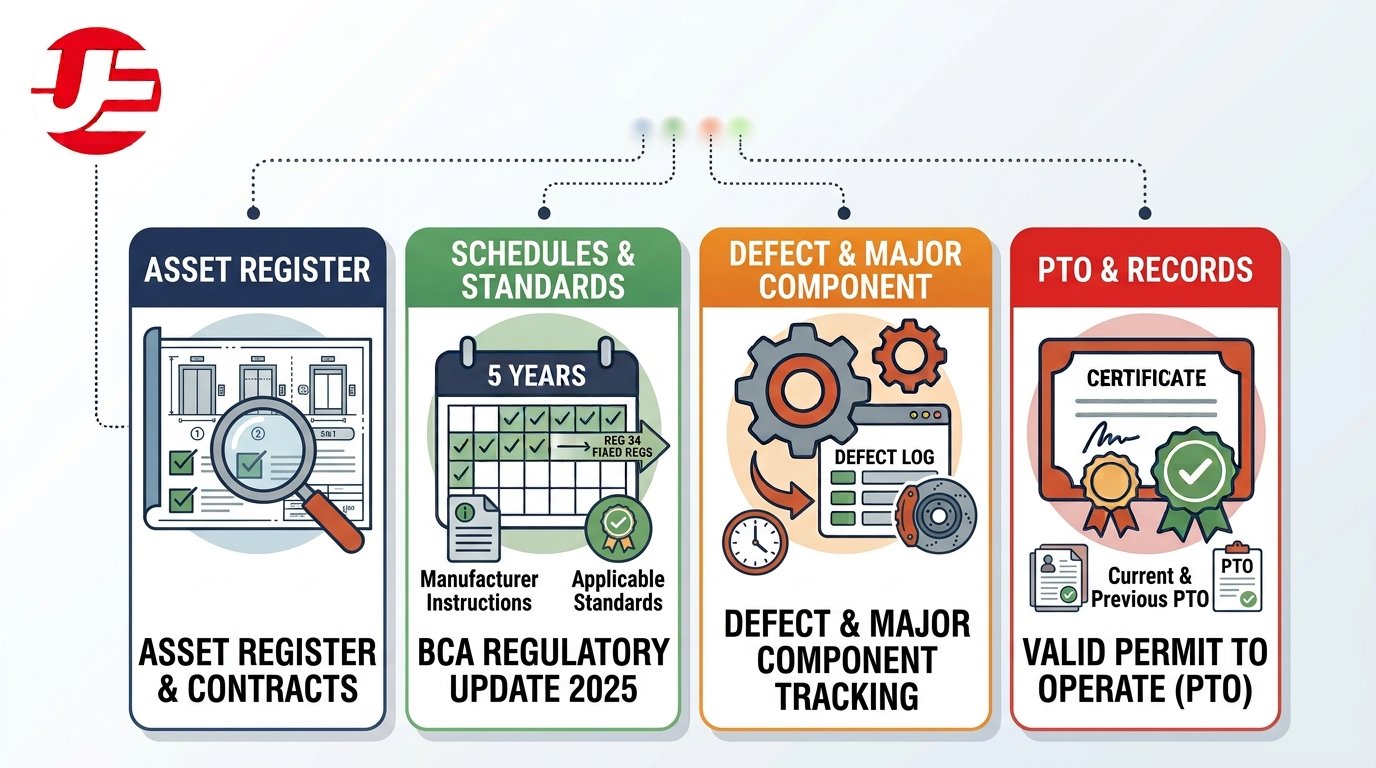
Singapore’s lift rules cover installation, operation, maintenance and safety oversight. For owners managing an existing lift, the central questions are straightforward: Is it safe to use? Is the maintenance arrangement appropriate? Have the required tests been completed? Is its PTO valid?
The BCA regulatory update explains the move from the previous BMSM framework to the Building Control (Fixed Installations) Regulations 2025 on 1 October 2025. Older articles can therefore contain terminology or processes that need checking before use.
Singapore Lift Maintenance Regulations should be considered alongside the equipment’s applicable standards, manufacturer instructions and any installation-specific conditions. A home lift and a shared passenger lift should not automatically receive the same servicing schedule.
For an owner, the practical starting point is an accurate asset register: identify every lift, its use, its contractor and the relevant dates. Understanding Singapore Lift Maintenance Regulations and BCA Requirements becomes easier when each obligation is attached to a particular asset and a named person.
Why Lift Safety Inspections Are Important
Lift safety inspections help establish whether equipment and protective systems are functioning as intended. Passengers experience the doors, floor alignment and ride quality; they cannot assess the condition of concealed machinery or the systems intended to protect them during a fault.
An elevator safety inspection also gives management a basis for decisions. A written finding can explain what needs attention, why it matters and what evidence is needed to confirm that the issue has been addressed.
Consider a building where users repeatedly report uneven stopping at one floor. Logging each complaint against the same lift gives the contractor a clearer starting point than passing on a general message that the lift “feels different”. This is an illustrative management example, not a report of a particular customer incident.
The value of inspection continues after the visit. Someone must read the findings, authorise necessary work and follow up on completion. Our article on why regular lift maintenance matters in Singapore buildings explores the wider relationship between preventive care and reliable daily operation.
What Are BCA Requirements for Lift Maintenance?
The answer begins with the lift’s category. BCA’s maintenance frequency table makes these distinctions:
| Lift category | Maintenance frequency |
| Lift serving a single residential unit | Manufacturer’s recommendation; every three months if no recommendation exists. |
| Stairlift or vertical platform lift not serving a single residential unit | Manufacturer’s recommendation or every three months, whichever is more frequent. |
| Other lifts, without an approved alternative schedule | Manufacturer’s recommendation or at least monthly, whichever is more frequent. |
| Eligible lift with an approved remote monitoring and diagnostics arrangement | The schedule approved in writing by the Commissioner of Building Control. |
These categories should be confirmed by the appointed contractor. Low passenger traffic alone does not establish a right to reduce maintenance frequency, and installing monitoring equipment does not by itself authorise a longer interval.
Ask for a schedule that identifies the visits, the equipment covered and the reporting arrangements. Keep annual testing visible as a separate commitment. For broader maintenance planning, see our complete guide to lift and elevator maintenance in Singapore.
Annual Lift Inspection Singapore: Timing and PTO Renewal
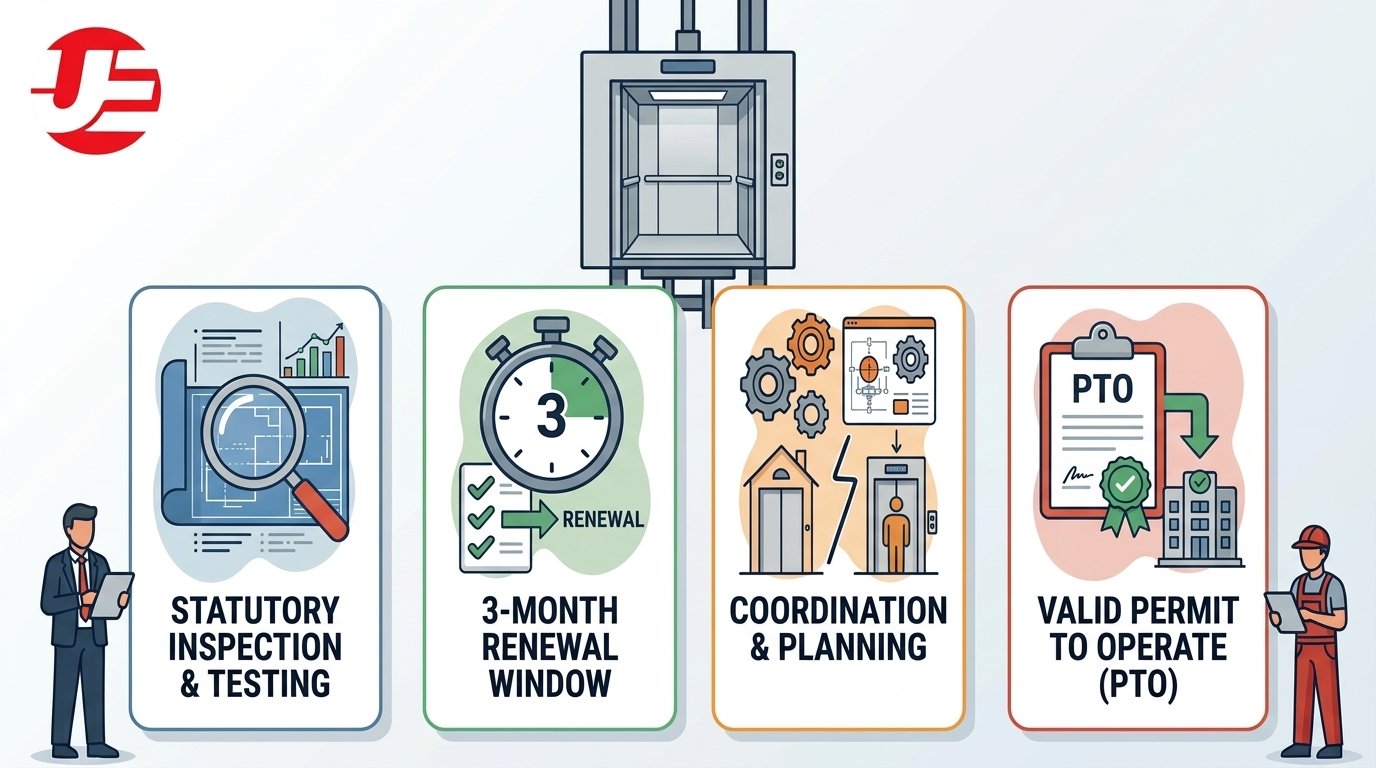
Are annual lift inspections mandatory in Singapore? Yes, for lifts within the applicable regulatory scope: BCA lists annual inspection and testing separately from periodic maintenance. A routine service visit should not be assumed to satisfy the annual testing requirement.
The PTO process is another part of the owner’s calendar. According to BCA’s PTO application guidance, owners or their representatives can begin renewal three months before the current expiry date. LEAP supports renewal, contractor updates and downloading issued certificates.
That early window gives management room to coordinate attendance, review outstanding findings and arrange access. It is sensible to build in time for corrective work rather than book everything immediately before expiry.
Applying Singapore Lift Maintenance Regulations and BCA Requirements means following the process through to completion. An inspection appointment, a contractor invoice and an issued PTO are different records. Check the actual permit status instead of assuming that a booked visit has completed the renewal.
Keep tenant notices and access arrangements in the same work plan, particularly where downtime affects residents who depend on lift access.
Who Is Qualified to Carry Out Lift Inspections in Singapore?
The contractor carrying out the work and the professional supervising statutory testing have different responsibilities. BCA’s current legislative guidance lists a BCA-registered fixed installation service contractor with an independent Specialist Professional Engineer (SPE) or Fixed Installation Inspector present for annual inspection and testing.
The statutory arrangement matters: an FI inspector assists under the appointed SPE framework; this should not be presented as every inspector independently replacing the SPE’s certification responsibilities.
Before appointing a provider, ask who will carry out the testing, who will supervise it and who will handle certification. Request names and current registration details rather than relying only on a company brochure.
Also distinguish a voluntary condition assessment from statutory testing. Both can be useful, but they answer different questions. A general assessment may help with budgeting or contractor selection; the annual statutory process has its own required participants and documentation.
Clear appointments make it easier to know whom to contact when a finding needs explanation or a submission remains outstanding.
What Happens During a Lift Safety Inspection?
The scope depends on the lift, the purpose of the inspection and the applicable requirements. An elevator safety inspection can involve reviewing records, examining equipment, observing operation, conducting required tests and documenting findings.
Areas addressed in BCA’s Lift Maintenance Outcome Guidebook include:
| Inspection area | Examples of matters reviewed |
| Doors and passenger protection | Door operation, protective devices and interlocks. |
| Emergency arrangements | Alarm, intercom, emergency power and lighting. |
| Movement and stopping | Ride behaviour and levelling at landings. |
| Mechanical equipment | Drive, brakes, ropes, guide components and safety gear. |
| Electrical systems and spaces | Controller condition, wiring and housekeeping. |
This is an owner’s overview, not a complete statutory test checklist or a procedure for untrained staff. The maintenance outcome guide also does not replace the applicable inspection and testing requirements.
Before the visit, make the relevant records and authorised access available. Afterward, ask for a clear distinction between completed checks, defects requiring action and any further testing needed. That distinction helps prevent an inspection report from becoming a document filed away without follow-up.
What Records Should Building Owners Maintain for Lift Servicing?
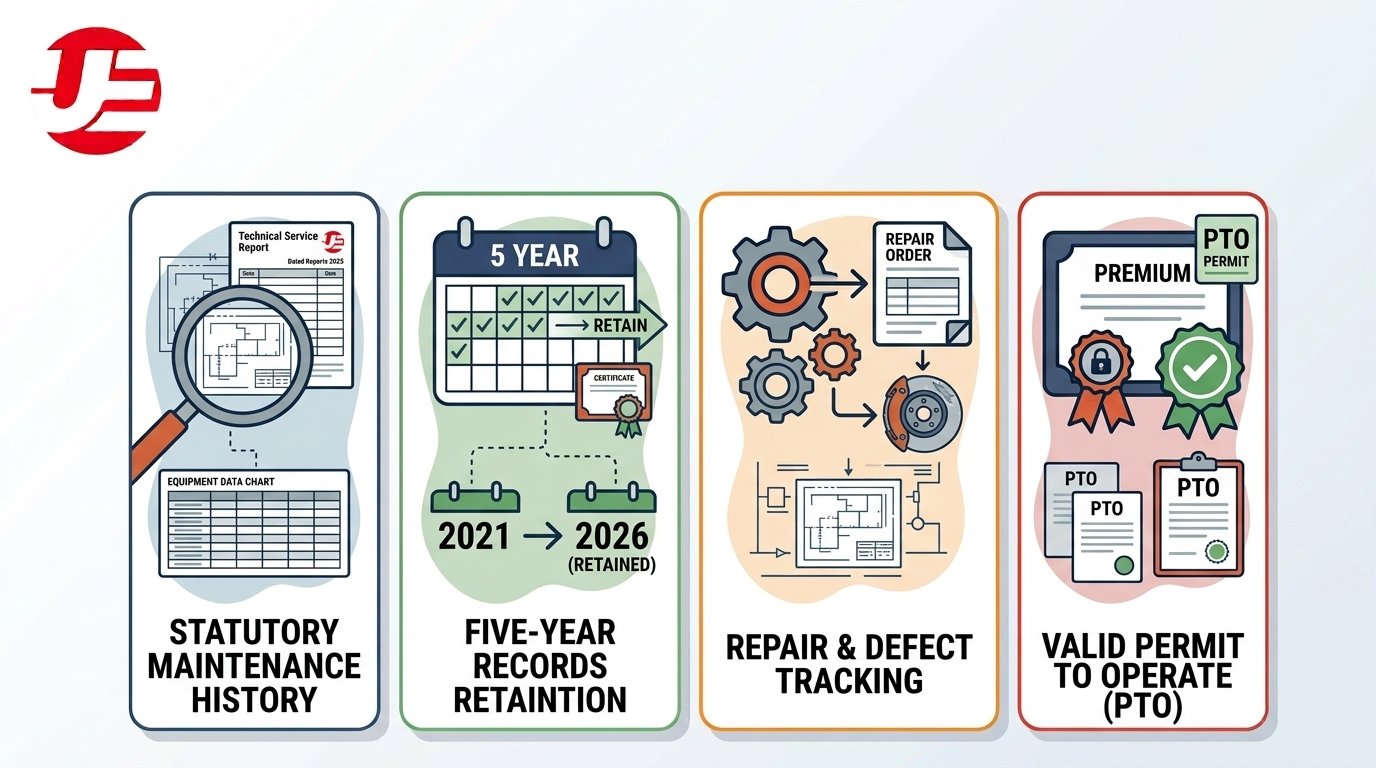
Owners should maintain a retrievable history of maintenance, inspections, repairs and certification. Regulation 34 sets out an owner’s duty to retain maintenance records, including relevant certificates and accompanying documents, for at least five years after they are made or issued.
Use a separate file or digital folder for each lift. A practical record set includes:
- Dated service reports identifying the equipment and work performed.
- Inspection findings, test reports and relevant professional certificates.
- Repair and replacement history linked to the original defect.
- Current and previous PTO information and renewal correspondence.
- Manufacturer documentation and applicable written approvals.
- Contractor appointment details and handover documents.
The five-year obligation concerns the relevant statutory maintenance records; keeping the additional management documents together is a practical recommendation. The fixed-installations regulations linked by BCA provide the underlying duties.
For example, if a report recommends replacing a component, connect it to the approved work order and completion report. An invoice alone may not explain the original finding or how completion was checked.
This record trail makes Singapore Lift Maintenance Regulations and BCA Requirements easier to manage when staff, managing agents or contractors change.
Lift Compliance Singapore: An Owner’s Action Plan
A useful compliance plan turns the regulatory overview into a small set of recurring management tasks. Start with the current position, then assign responsibility for anything missing.
| Management task | Evidence to check |
| Identify each lift and its category | Asset details and contractor confirmation. |
| Confirm the maintenance arrangement | Current appointment, scope and agreed schedule. |
| Track statutory testing and PTO renewal | Test appointment, submitted documents and issued permit. |
| Review unresolved findings | Action owner, target date and closure evidence. |
| Maintain continuity | Accessible records and an agreed contractor handover process. |
This checklist is a management aid rather than an exhaustive statement of legal duties. Owners should also check the requirements for changes to equipment: BCA explains that major alteration or replacement works can end the existing PTO and require notification, applicable approvals, supervised work and a new PTO before operation resumes.
The detailed regulations child article should expand on those specific obligations. Here, the essential principle is to review compliance whenever the equipment, contractor or operating arrangement changes, as well as at scheduled renewal points.
Treat Singapore Lift Maintenance Regulations and BCA Requirements as an ongoing programme with visible records and accountable people.
What Should Owners Do About Defects or Safety Incidents?
First establish whether the lift can remain safely in operation. Refer technical findings promptly to the appointed professionals and follow any required restriction or stoppage. Building staff should not attempt technical repairs or passenger rescue without the appropriate training and authority.
For management, a simple action log is useful: record the affected lift, the observation, who was contacted, the advice received and the next action. Do not close an item merely because the complaint has stopped appearing.
Regulatory reporting is separate from calling the maintenance company. BCA’s reportable-matters guidance distinguishes reportable safety incidents from reportable safety risks and specifies reporting channels and deadlines. Refer to that current guidance immediately when an event may be reportable.
For planned repairs, ask whether the proposed scope is ordinary corrective work or a major alteration requiring a different process. A contractor should explain the classification before management approves the programme and any associated shutdown.
How to Choose a Lift Maintenance and Inspection Partner
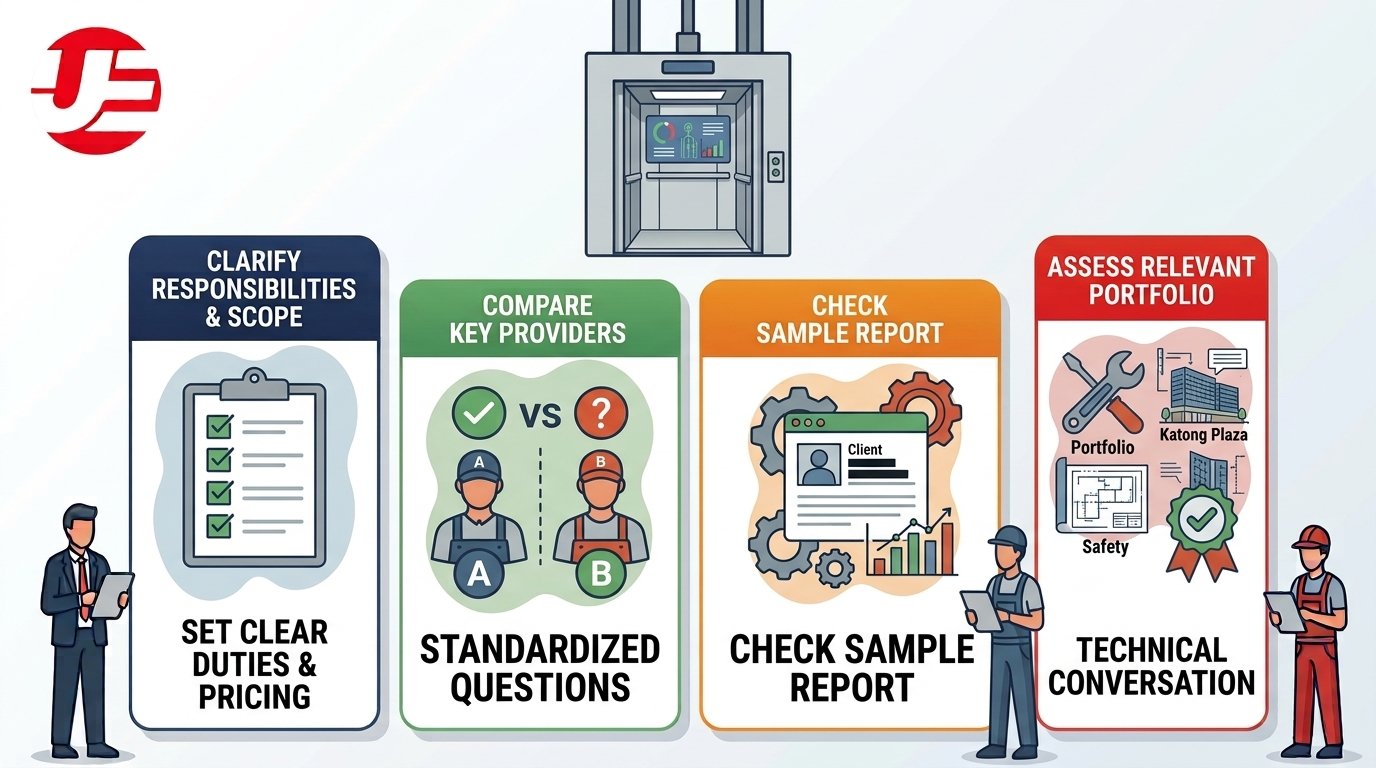
A useful proposal makes responsibilities clear enough that another member of your management team could understand them without attending the sales meeting.
Compare providers using the same questions:
- Who is responsible for statutory inspection coordination and certification?
- Which visits, reports and renewal tasks are included in the price?
- How are urgent faults escalated outside normal working hours?
- Which replacement parts or additional tests are excluded?
- How are findings prioritised, quoted and closed?
- What records will management receive during the contract and at handover?
Request a sample report with customer information removed. Check whether it identifies the lift, explains findings and records what happens next. A polished proposal is less useful than a reporting process your team can actually follow.
At Union Jack Elevator, our published maintenance and repair portfolio includes maintenance/modernisation projects at Our Tampines Hub and Katong Plaza. These provide concrete examples of our project background for owners assessing a potential service partner.
Ask us how that background relates to your equipment and building needs. Project names are a starting point for a technical conversation; the proposed scope should still be specific to your lifts.
Plan Your Next Steps with Union Jack Elevator
Start with three documents: the current PTO, the latest service report and any open inspection findings. Together, they give your team a practical starting point for discussing the next visit, an approaching renewal or unresolved work.
Union Jack Elevator provides maintenance, repair, testing and modernisation services. When making an enquiry, share the lift brand, building type, number of units and the issue you need help with. Include the next relevant deadline so the discussion can address timing as well as technical scope.
The goal of understanding Singapore Lift Maintenance Regulations and BCA Requirements is to make better decisions about your building’s lifts, supported by clear responsibilities and documented follow-through.
Contact Union Jack Elevator to discuss your maintenance requirements and the appropriate next steps for your equipment.
FAQs
What are Singapore’s lift maintenance regulations?
The current framework includes the Building Control (Fixed Installations) Regulations 2025. It covers responsibilities relating to safe operation, maintenance, testing, records and permits. The requirements applicable to a particular lift depend on its category and any relevant exemption or approval.
Are annual lift inspections mandatory in Singapore?
Yes, for lifts within the applicable regulatory scope. BCA lists annual inspection and testing separately from scheduled maintenance. Owners should coordinate both and monitor the PTO renewal process rather than treating a routine service report as evidence of annual certification.
What are BCA requirements for lift maintenance?
Use an appropriately BCA-registered service contractor and follow the frequency and maintenance requirements applicable to the lift. The manufacturer’s recommendation, lift category and any written approval for an alternative schedule must be considered; one universal interval does not apply to every lift.
Who is qualified to carry out lift inspections in Singapore?
For annual statutory testing, BCA identifies a registered FI service contractor and independent SPE/FI Inspector attendance. The appointed SPE and any assisting FI Inspector have defined responsibilities. Confirm the actual supervision and certification arrangement before booking.
What records should building owners maintain for lift servicing?
Retain service records, inspection and test reports, relevant certificates and accompanying documents, with at least five years’ retention for statutory maintenance records. Keep PTO details, approvals and repair history accessible alongside them so your team can follow each lift’s compliance history.