
The modern Singaporean buildings have commercial lifts that are necessary in the buildings and offer safe and reliable vertical movement to offices, malls, hospitals, and industrial settings. Such lifts guarantee the free flow of people, equipment and goods across floors and improve the efficiency of operations and assure safety standards are also observed. A commercial elevator lifts will enhance accessibility of all building users, regulatory compliance and streamline workflow in multi-storey buildings. Facility managers and building owners planning effective vertical transportation desire to have knowledge in the types, features, and benefits of commercial lifts.
What does a Commercial Elevator Lift Mean?
Commercial elevator lift is a motorized elevator lift that is special to buildings of business and industry. They are capable of supporting more weight and are used more often, as well as meet stringent safety standards, unlike residential lifts.
These lifts are safe and effective in transportation of employees, clients and equipment across the floors. The automated controls, emergency brakes, and obstacle sensors are common in commercial lifts in Singapore. They also enhance friendliness to the person with mobility limitations, which makes them both inclusive and convenient. The right lift will increase efficiency of operations and make vertical movement in buildings safer and smoother.
Importance of Commercial Lifts in Modern Buildings
Commercial lifts are essential to the present day buildings due to the efficient and safe movement in vertical direction, planned by commercial lift specialists. The offices, shopping complexes, hospitals, industrial sites, use lifts to help transport people and goods.
One of the commercial lifts is office elevators, which allow to minimize waiting time and workflow. These lifts also keep safe and access regulations within the area at par to make it much more convenient to all users. They are implemented in order to decrease the potential of accidents, to sustain energy efficiency, and to enhance the general experience of the commercial property in Singapore.
Different Types of Commercial Lifts
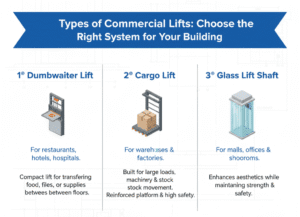
There are several different types of commercial lifts which fulfill various business requirements. The knowledge of the types will enable the facility managers and building owners to choose the best lift to use in the building.
Such as straight lifts, curved lifts, dumb waiter lifts, cargo lifts and glass lifts shafts. Every type is specialized in its operations, whether it is to transport people or goods transport or providing modern design looks. The selection of the appropriate type guarantees efficiency in the operation, safety, and satisfaction in the long run.
Dumbwaiter Lifts
Dumbwaiter lifts are small space saving elevators that help to move goods instead of people. They are used in restaurants, hotels, and hospitals and it helps to ease the transportation of supplies, documents or even food between floors.
Such lifts have limited space and can be installed in small spaces without significant adjustments in building structures. The size of the dumbwaiters can be adjusted to various commercial amenities in Singapore depending on the usage. They enhance the efficiency of the workflow by minimizing manual work and wastage of time.
Cargo Lifts
Commercial cargo lifts are robust tools that are used to safely transport big goods, machinery or equipment across the floors. These hoists are common in warehouses, factories, shopping centers, and other business institutions requiring heavy objects to be moved on a regular basis.
The cargo lifts are constructed in such a way that they last long; they have the reinforced platform and safety provisions to ensure the protection of the load as well as the users of the building. The use of cargo lift enhances the efficiency of operations, minimizes accidents at the workplace, and facilitates flawless logistics in commercial buildings.
Glass Lift Shafts
Glass lift shafts are contemporary lifts that have transparent walls and they are functional and attractive to the eye. They are mostly used in offices, malls and commercial centers to beautify the interior design as well as offering secure vertical circulation.
Glass lift shafts have the option to be designed to fit the architecture of the building and provide floor visibility. They also incorporate the standard safety features and can be applied to buildings of different sizes in Singapore. These lifts enhance user experience: Design aesthetics are combined with efficiency and safety.
Traction and Hydraulic Lifts
The traction lifts employ ropes and counter weights to travel smoothly and consume less energy and are suited in mid- and high-rise commercial structures. Hydraulic lifts are driven by a piston system and are best suited to low-rise to mid-rise buildings; in addition, they are easy to install and they have a steady operation. They are both common in the commercial areas due to their dependability, security, and flexibility.
Size Specifications of Commercial Lifts
A very important issue in designing vertical transportation in any building is commercial lift size. The standard dimensions are based on the nature of lift, the purpose and the design of a building. Straight lifts tend to be smaller and can fit into offices and HDB-style commercial buildings whereas curved lifts have larger footprint because of the rail design.
Passwords of lift to be used in commercial buildings should be able to carry the number of passengers, weight and, in certain situations, wheelchair bound individuals. Cargo lifts take up a lot of space to ensure that it can handle heavy cargo safely.
The facility managers and owners of the buildings in Singapore must consider the available sizes of stairwells or shafts in order to select a lift that can fit without significant adjustments. The correct planning guarantees security, observing of standards, as well as efficiency in operations and maximizing the use of space.
Business Elevator Lift Characteristics
Business elevators are featured with a number of main peculiarities that guarantee its efficiency, safety, and ease in functioning:
- Installed with motors, rails, control panels and hi-tech safety sensors.
- Motors with reduced power consumption and automatic systems save the operations cost and ensure uniformity in performance.
- Emergency stop buttons, emergency alarm systems, and emergency power outage backup batteries.
- The handrails are 220-volt durable and sleek ride systems to improve comfort to the user.
- Through regular maintenance, longevity and daily operations can be guaranteed.
- New objects enhance safety, productivity at work, and professional image.
Safety Valve of Commercial Lifts
These lifts are concerned with safety. The safety aspects of commercial lifts have advanced features like seatbelts, obstacle detection, emergency stop and smooth braking.
Commercial vertical wheelchair lifts are also accessible, and they facilitate the easy and comfortable movement of people with mobility difficulties. Additional security features such as automatic access doors, anti-entrapment sensors and backups are added.
These safety features will guarantee that the building meets the requirements of the Singapore regulations, as well as giving the building owners and occupants peace of mind.
What is the Cost of a Commercial lift in Singapore?
Prices of commercial lifts are up to the type, size, features and installation needs. Straight lifts are more affordable as compared to curved or tailor-made lifts to multi-turn staircases which may be considerably expensive. Other considerations that influence prices of commercial lifts include safety options, motor type and control systems.
The cost of maintenance and servicing should also be put into consideration in order to have long-term performance. Building owners in Singapore must not focus on the initial low price but rather they must put value above all to ensure that they do not compromise on safety, durability and efficiency by choosing a lift that will last longer. Knowing these factors of costs assist the business in making accurate budget plans without incurring costs in the future.
Commercial Lift Installation Process
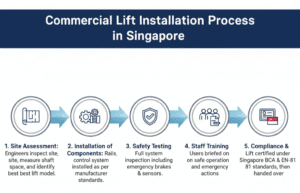
The placement of a commercial lift is a matter of great concern that the installation should be performed by a professional in order to be safe, efficient, and comply with the regulations. When the lift is installed in the right order, it will run smoothly and safely to all the users of the building.
Step One: Profession Assessment
- Installed certified installers do a site assessment.
- Survey space, assess building needs.
- Establish the best kind and model of commercial lift to the building.
Step 2: Component Installing
- Certified technicians install rails, control systems and motors.
- Installation is provided in line with the specifications of the manufacturer to provide safety and professional commercial lift installation.
Step 3: Safety Testing
- Carry out extensive safety tests of the lift system.
- Check on emergency stop functions, sensors and safety of operation.
Step 4: Staff Instruction
- Train workers should be trained to use the lifts properly.
- Communicate emergencies and safety measures.
The fifth step is compliance and handover
- Have the lift up to Singapore standards and regulations.
- Assure of proper functionality even in busy buildings.
- Transfer the lift with complete functionality to the building owner or facility manager.
Commercial Elevator Lifts Lifespan
Commercial lifts on elevators are designed to last and have a lifespan of between 15 to 25 years, depending on how it is used, maintained and the quality of parts. Periodic maintenance guarantees that motors, control systems and safety mechanisms are working properly so as to extend the working life of the lift.
The use of the best elevator helps to minimize the downtime, minimizes repair work and guarantees an efficient vertical transportation in the rush buildings. Well-maintained lifts still offer safe and reliable services over the years and help in the effective running of business and its adherence to safety standards in Singapore
Commercial Vertical Wheelchair Lifts
Business wheelchair lifts make sure that people with mobility problems can access the building, whether publicly or privately, and thus be included. The lifts are in line with the Singapore laws and safety measures, with such amenities as automatic doors, anti- entrapment sensors, and even power backup.
Vertical wheelchair lifts enable the safe vertical movement without the user leaving his wheelchair making it more convenient and independent. These lifts should be in the building planning of facility managers to address the need to achieve accessibility and enhance the experience of the user.
Office Elevators – Making business processes lean
Commercial lifts are office lifts which are intended to maximize the efficiency of the work place. They minimize the time of waiting, enhance the vertical traffic movement, and facilitate the easy functioning of several floors.
Office building commercial lifts make the movement of the employees, clients and visitors safe and efficient, eliminating the bottlenecks of places of work during the peak times. The inclusion of office elevators that are well designed makes the building look professional in addition to increasing productivity and user satisfaction in general.
Selecting the appropriate Commercial Elevator to your building
The choice of an appropriate business elevator must be done with a lot of deliberation with regards to the building type, the number of people or cargo to be transported, and the design type. The aspects like weight capacity, availability of space and adherence to safety measures are essential.
Modern commercial elevators are fitted with energy efficient motors, modern ride mechanisms, and commercial features that enhance efficiency. Singapore facility managers and building owners are to compare the types, sizes of lifts and costs of lifts so as to get a solution that suits the long term needs of businesses and at the same time make sure that the lift remains safe and all the users can access it.
Starting up a Business of Commercial Lifts in Singapore
As an entrepreneur who is interested in the lift industry, it is important to know more about commercial elevator lifts. The awareness of the market demand, local laws, supplier channels and installations are essential to start up a business successfully.
Commercial lifts on the elevator must have licensed installers, maintenance personnel as well as availability of quality components. Knowledge of client needs, code of buildings and Singapore safety regulations is a sure way of providing reliable services. When a business strategy is well planned in terms of quality, compliance and customer support, the commercial lift company is set to succeed in the long term.
Commercial Lifts: Straight and Curved or Platform
The comparison of the types of commercial lifts assists in identifying the most suitable ones to be used in relation to the needs of the building. Straight lifts are affordable and effective in simple plans whereas curved lifts are effective in staircases that have turns or curves. Cargo lifts or platform lifts are ready to accommodate the heavy-duty or wheelchair access.
Design and size of lift influence space use, functionality and installation expenses. The owners of buildings in Singapore must consider advantages and disadvantages of each of the types, such as the load capacity, the possibility of customization and even the energy efficiency. The given comparison provides the selected lift with operational, safety, and budget necessities.
Maintenance and Service of Commercial Lifts
Commercial elevators should be maintained properly to promote safety, reliability and longevity. Periodic maintenance also aids in avoiding breakdown, lowering maintenance expenses, and is performed by certified lift maintenance and repair technicians. Routine maintenance normally involves inspection of motors, control systems, safety sensors and mechanical parts to ascertain that they are in compliance with the Singapore laws.
Properly maintained commercial lifts are efficient and minimize downtime as well as user safety. Facility managers are supposed to collaborate with certified technicians in an attempt to develop a maintenance schedule and keep an account of all service activities.
Professional service investment increases the life cycle of commercial lifts and reduces the unexpected disturbances in operations, maintaining operations of the business without hitches.
Troubleshooting Common Commercial Lift Issues
Commercial lift elevators are usually affected by the slow movement, door problem, or sensor problems. Examples of common troubleshooting actions are:
- Detect any minute delays by straddling rails or blockage in the track.
- Reboot the control panel to correct slight system failures.
- Seek the help of qualified technicians in matters of installation.
- De-technify the complex issues to facilitate easy resolution by the facility managers.
The frequent troubleshooting makes sure that the lift is operated in a safer way and lasts long.
Safety Standards and Commercial Lift Regulations in Singapore
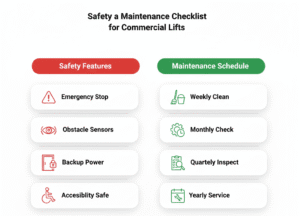
Singapore commercial lifts should be of a high standard in terms of safety standards such as EN-81 standards as well as local building codes. The commercial lifts must be properly installed by certified installers, so as to comply with legal and safety standards.
Some of the safety features include emergency stop functions, obstacle detection, load capacity, and wheelchair users. Accidents can be avoided through regular inspections and compliance with regulations, which enhances reliability as well as gives confidence to the owners and occupants of the building. The selection of certified commercial lifts will make sure that business and users are not liable due to the liability concerns.
Conclusion
The commercial elevator lifts will improve the safety, efficiency, and accessibility in Singapore business. These lifts make work easier, minimize the chance of accidents, and make workloads more enjoyable to the employees, customers, and visitors.
The selection of the appropriate lift, regular maintenance, and adherence to safety criteria are the factors that guarantee ROI in the long run. To owners of the building and managers of the facilities, business elevators are a competitive expenditure that underpins the seamless operation, and regulatory conformity and expansion of business. Association with the certified suppliers and installers will ensure quality performance and relaxation in the years ahead.
Frequently Asked Questions
1. What are the influencing factors with regard to commercial lift price in Singapore?
The commercial lift price varies based on various factors including the type of lift, size, weight capacity and bespoke options. The cost may also be affected by installation complexity and choice of brand.
2. What is the estimated time to make a commercial lift installation?
The installation of a commercial lift normally consumes a time ranging between 4 to 8 weeks based on the structure of the building, the requirements of the design and the local safety checks.
3. What is the size of an average lift of a commercial building?
Depending on building use the commercial lift size will change. The office and retail lifts are generally smaller whereas the cargo lifts are larger to accommodate the heavy cargo.
4. What can I do to be sure that I abide by local lift standards in Singapore?
In order to comply with the rules, hire certified installers aware of the commercial lift Singapore safety standards. They make sure that the lifts are in accordance with the EN-81 and local codes.
5. What is the frequency of the maintenance of a commercial lift?
Commercial lifts are to be serviced after every 3 to 6 months in order to be safe and reliable. This is because regular checks minimize downtime and increase the life of the equipment.