
The contemporary warehouses and manufacturing facilities demand the effective vertical movement to facilitate unconstrained operations. A good example is the installation of an industrial elevator lift to enable businesses to move materials across floors in a safe and efficient manner. The elevator industry is experiencing a growing need to have equipment that can increase the efficiency of the operations of the industry, whilst ensuring that the hazards at the workplace are limited.
Implementing these systems, companies are able to avoid accidents, decrease downtime and enhance the overall productivity. Furthermore, elevators and lifts in factories will allow maximizing horizontal space and smoothen out the working process, making it possible to work on the goods and materials faster. It is to make sure that facilities are well arranged as well as to promote long-term growth and reliability of operation.
What Is an Industrial Elevator Lift?
Industrial elevators are used to carry heavy weight in industries. Industrial elevator lift is a sure method of transporting raw materials, equipment, and finished products up and down. These elevators are not like residential and commercial elevators, in terms of weight capacity, construction, and usage frequency. Manufacturing plants, logistics centers, and stores are the typical locations where industrial elevators and lifts are implemented in order to save the labor force, raise the safety level, and increase the efficiency of work.
These lifts allow business to have a smooth workflow in many floors besides safeguarding employees against body pains and accidents at work places.
Key Functions of Industrial Elevators in Business Workflow
Industrial elevators enable heavy weight materials to move up and down the building without the use of labor. They assist in streamlining the workflow and reduce the delays in operations particularly in the warehouses and manufacturing plants. The storage space is also optimized with the efficient use of these systems as they create better organization and speed of handling goods.
Types of Industrial Elevator Lifts Used in Today’s Facilities
There are different vertical transport systems that are used by industrial facilities depending on the load and operational requirement. Learn more in our industrial goods lift guide. In industry, elevators and lifts are also industrially dependable to facilitate the movement of materials and machinery to enhance efficiency and cut down on the amount of manual work done.
Facilities have the option of lifts that are based on the height of the floor, frequency of use and space. The industrial lift elevators are also durable and can be modified to meet the industrial specifications.
Industrial Freight Elevators
The freight elevators are constructed in such a way that it can easily carry the heavy goods and machinery. For detailed specifications, see this freight elevators guide. They are well built to guarantee their longevity as well as stability in harsh environments. These elevators are capable of supporting high capacity load hence suitable in manufacturing plants and big warehouses where vertical transportation is needed often.
Goods & Cargo Industrial Warehouse Lifts Elevators
These lifts will be used in medium to light goods, and will offer efficient vertical movement in the storage facilities. Industrial lifts elevators and warehouse industrial lifts are mostly utilized in distribution centers where frequent transportation is required. They are designed in such a way that inventory is easily handled safely on several floors.
Hydraulic Elevator
Industrial buildings with low rises are suited with hydraulic elevators. This type of system type elevators have a smooth motion and are less expensive as compared to facilities that do not need quick vertical movement.
Traction Industrial Elevator Systems
Traction lifts are applicable in high buildings of more than one story. They are also low-consumption of power and have higher speeds of traveling but have a counterweight balance to allow ease of operation. The industrial lifts of this nature are mainly used in multi level warehouses and factories.
How Industrial Elevators Work: Components & Control Systems
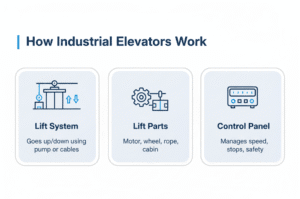 Industrial elevators are either hydraulic or traction powered. Motors, cables and pulleys are used to provide efficiency in the lifting of heavy loads. The controls of elevators are used to control the velocity, stopping, and the safety of the various mechanisms in order to make the control reliable. Well-designed controls eliminate wear and tear in the system and ensure business efficiency and safety of workers.
The use of industrial elevators would also require the monitoring of the performance, detection of overloads, and prevention of accidents in the case of high-frequency usage.
Internal Safety, Sensors & Automation Controls in Industrial Elevators
In the industrial vertical transport safety is a major concern. Automated controls, sensors and emergency brakes guarantee uniform operations and avoidance of accidents. With the introduction of industrial elevator control, facilities are able to ensure safe operation as it will keep itself reliable and protect the employees too as well as reducing the amount of downtime.
Benefits of Choosing Industrial Elevators and Lifts for Your Business
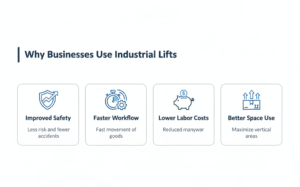 Elevator lift installation can greatly improve the safety of the workplace as it will minimize the number of accidents. There is also an acceleration in the work flows, which enhances the productivity in the facilities. Industrial lifts and elevators minimize manual labor and thus save the cost of operation and leave employees to undertake additional functions. Also, industrial lifts make good use of the vertical space in factories and warehouses, which enables effective use of the floor space and has a more structured storage. Selecting the appropriate system prosecutes effective material handling, helps in long term operational objectives, and enhances facility operation.
Best Uses of Industrial Elevator Lifts in Warehouses and Manufacturing
Vertical transport is a key component in industrial facilities that need raw material to be transported efficiently, finished products and heavy machinery. An industrial lift lift is used to enhance the flow of operations in the manufacturing facilities, warehouse and distribution centers. This elimination of manual tasks will enable the business to improve safety without increasing the rate of production.
Such lifts come in handy especially when there is a need to move large quantities of products between the various levels to help in facilitating time-sensitive operations. Industrial lifts used in facilities to serve warehouses or industrial elevators have the advantage of less labor needs, higher speed of inventory movement and increased organization of the facility.
Manufacturing Plant Industrial Elevators
These elevators transfer components and machines in a safe way among assembly lines. Such systems enhance accuracy and minimization of the potential harm to the system besides allowing workers to execute their duties effectively.
Industrial Lifts for Warehouses & Distribution Centers
The warehouse lifts will save time and labor and move the stock up and down the various floors. Warehouse industrial lifts assists in streamlining the distribution, packaging effectiveness and enhancing quickness in processing orders.
Safety Standards for Industrial Elevators: What Businesses Must Know
The level of safety in industrial facilities should be high because it can facilitate the process of functioning and avoid accidents. The EN 81 series is used globally to offer detailed design, installation, and maintenance guidelines on elevators. Adherence to such standards will provide equipment with safety standards, which can be used in daily industries. Also, domestic safety standards, like the standards of industrial elevators Singapore, have to be followed in order to be compatible with the national standards.
These safety measures and regular inspections are essential towards operational integrity and the safety of employees. Through adherence, companies are able to reduce risks, prolong the lifespan of equipment and save on the expensive fines.
How to Choose the Right Industrial Elevator Lift
The choice of lift should be done with proper consideration of the requirements of the facilities. An industrial elevators lifts ought to be in line with load capacity, floor levels, and shaft space available. It is also necessary to consider how often it is used and how it can be expanded in the future. The proper system will provide efficient and safe material handling, as well as aid the business expansion.
There is a strong necessity to compare various models, structures, and vendors when evaluating options. Industrial lifts are likewise offered as a purchase by the facilities that seek to purchase them to get maximum combination of cost, life and performance. The selection of the lift type to the operational needs ensures efficiency and productivity in the long term.
Comparing Industrial Lifts for Sale: Capacity, Speed & Structure
A business ought to contrast lift choices according to capacity, travelling velocity and the design. The process of reviewing industrial lifts being sold will assist in determining the difference between standard and customized solution. The appropriate system selection will guarantee ROI, minimize downtime, and promote operational reliability in the long run.
Cost Breakdown: What the businesses need to expect when using industrial elevators
Industrial elevators have a variety of prices that are dependent on various factors. The cost of installation covers the cost of building the shaft, the preparation of the pit, and integration of power systems. The upfront expenses may be increased by customization, e.g. better controls or special cabins. Automatic maintenance and energy usage are recurrent running costs. By investing in the quality of equipment, it is durable and the cost saved in the long run. When elevators are used in business, then the budgets can be planned with these factors in mind, and hence informed financial decisions may be made.
Installation Requirement of Elevators and Safety Controls in industry
The safe and efficient functioning of industrial elevators is based on proper installation, which can be ensured by a professional lift installation. The pre-installation consideration should include site feasibility, shaft dimensions and depth of the pit. Sufficient power supply is crucial in smooth lift functioning. Proper installation of industrial elevator control systems guarantees accurate operation, accidents are avoided and the equipment life is prolonged. Compliance with installation guidelines keeps the safety level and minimizes the risks of the expensive downtime.
Maintenance Guide for Industrial Elevators and Lifts
Lifts are maintained regularly to enable them to act safely and effectively, with support from expert lift maintenance services. Regular checks are made on possible problems before it results in failures. Lubrication points, sensors, and control panels are some of the components that should be periodically checked. Safety regulations make industrial lifts and elevators reliable and are also functional. Preventative maintenance helps to minimize downtimes, increase the life of equipment and helps to maintain uniform workflow in the warehouses and manufacturing plants.
Elevator Industry Problems and how to prevent them

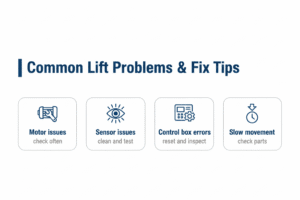
- Industrial lifts can experience failure of the motor, sensor, or control system which can interfere with performance.
- These issues may lead to expensive changes in workflow and operational delays in factories and warehouses.
- By preventing the similar causes in time, the businesses will be able to act in a timely manner.
- The reliability of equipment and its safety is ensured through routine checks, appropriate lubrication and professional assistance.
- The control of industrial elevators to avoid accidents and possible failures of the working process as well as to avoid disruptions in the daily work of the facility is monitored.
Future Trend: Industrial Elevators in Singapore and the World markets
The elevator industry is emerging extremely fast with the implementation of intelligent and automated systems. Singapore and the rest of the world are witnessing the introduction of increased use of the IoT technology in the industrial elevators as a more effective means of monitoring and control. Green buildings and energy-saving designs are the new trend in contemporary facilities. The increasing demand in Asia and other areas is an indication of a move towards better safety standards and operational efficiency. Companies that have invested in such trends would enjoy state-of-the-art features and sustainability.
How to Choose a Trustworthy Industrial Elevator Lifts Supplier
Using a reliable supplier guarantees the reliability and the support in the long run. Explore more solutions at our trusted elevator and escalator company. Consider certifications, experience and past project portfolios, and only purchase them. The key factors are after-sales service, supply of spare parts and technical support. A supplier of industrial lifts to sell ensures that the installations are done well, maintenance is handled, and performance is constant. A good supplier makes your elevator efficient and safe during its period of use.
Conclusion
Installation of an industrial elevator lift adds a lot of value to any industrial. These systems elevate the safety of the work environment, facilitate the workflow, and contribute to the increased productivity of several levels. Once companies are aware of the various types of lifts, installation requirements, safety measures and the source of suppliers, they are in a better position to select a system that aligns with their process. Proper choice of lift will decrease the work load, minimize the waiting time, and create a steady material handling even when operations are at peak. Investing in a more stable and properly-ownership solution can enable companies to realize efficiency and easier performance in the long-term within the manufacturing or warehouse context.
FAQ
What is an industrial lift?
It is a mechanism of transporting heavy materials and equipments across the floors. Its use is in warehouses, factories, and logistics centers that are high capacity.
What is the importance of industrial elevators to businesses?
They automate the workflow and minimize the amount of manual work. Also enhance safety and make use of vertical space in the industrial plants.
Which kinds of elevator lifts used in industries are available?
Freight lifts, goods and cargo lifts, hydraulic lifts and traction lifts. Every type is chosen according to the load capacity and the building height.
What are the working mechanisms of industrial elevators?
They are powered by hydraulic, traction systems, motors, pulleys and cables. Control panels are used to control speed, stopping and safety functionality because they are reliable.
What is the way businesses select the appropriate industrial elevator lift?
Take into account load, number of floors, shaft space and frequency of use. Planning should also be done about future growth and operations.
What are the safety things that industrial lifts have?
Has overload sensors, emergency brakes and automatic controls. EN 81 standards provide a safe and reliable operation.